Larys Strong
Fire & BloodLarys Strong, called the Clubfoot, was the younger son of Lyonel Strong and became Lord of Harrenhal after his father and elder brother died in a fire whose cause remained unknown. As master of whisperers, he moved between rival courts and crises with a reserve that concealed his intentions. He helped the Greens bind themselves by a blood oath, later arranged Aegon II’s escape from King’s Landing, and repeatedly turned information into leverage. His career ended with a conviction for regicide and treason, but the motives behind many of his choices remained unresolved.
Identity and Position
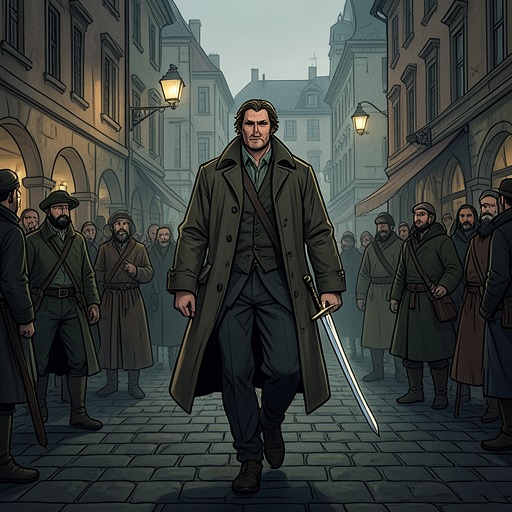
Larys came to court with the rest of his family after King Viserys invited his father, Lyonel Strong, to join the small council as master of laws. Larys entered royal service as one of the king’s confessors. His elder brother, Ser Harwin Strong, became a captain in the gold cloaks, while his sisters served as handmaids to Princess Rhaenyra. The family’s place at court connected Larys to both the royal household and the political conflicts that would later divide it.
After a fire at Harrenhal killed Lyonel and Harwin, Larys inherited the lordship. The blaze’s origin was never established. Suggestions ranged from accident and the castle’s supposed curse to deliberate arson. The proposed culprits included Corlys Velaryon, Prince Daemon Targaryen, Larys himself, and even King Viserys. The accounts offer no resolution, leaving Larys’s inheritance shadowed by suspicion rather than proof.
By the eve of the succession crisis, Larys held two forms of influence: he was Lord of Harrenhal and master of whisperers on the king’s council. He served under Aegon II as well as under Viserys. His office gave him a position within the machinery of government, while his deliberate quiet made it difficult for other councillors to know what he had heard or where his loyalties lay.
Silence, Oaths, and Allegiance
Larys’s characteristic method was to listen before speaking. During a debate over whether to crown Aegon II, the accounts record no contribution from him. That silence was consistent with his preference for withholding words, even though he could be fluent and persuasive when circumstances demanded it. When the conspirators moved from debate to commitment, however, he took the initiative. He proposed that they swear first, drew a dagger across his palm, and urged a shared blood oath. The other conspirators followed; Queen Alicent was excused from the rite.
His position did not make him a straightforward partisan. After Lucerys Velaryon’s death, the history describes Daemon Targaryen as having allies among the gold cloaks, at court, and even within the green council. Daemon also relied on a trusted intermediary who could move through the city’s less visible places. The account does not identify that intermediary as Larys, and his precise part in this network remains uncertain. It does establish the broader setting in which information and secret access crossed the lines dividing the factions.
As Aegon II’s master of whisperers, Larys compiled a list of the lords who had gathered on Dragonstone for Rhaenyra’s coronation and joined her black council. The list helped expose mainland supporters to danger. Ser Criston Cole then led a royal force against Rosby and Stokeworth, compelling their lords to support the crown, before advancing on Duskendale. Larys’s record-making thus contributed to a campaign that turned intelligence into military pressure, although the account does not describe him as commanding the expedition himself.
The Fall of King’s Landing and the Escape of Aegon II
When Rhaenyra’s forces threatened King’s Landing, Larys secretly got Aegon II and his children out of the city. He led them through a concealed passage built in Maegor’s Holdfast, avoiding the city gates where they might have been recognized. His plan also separated the fugitives so that the capture of one would not automatically expose the others. Ser Rickard Thorne was assigned to take Maelor to Lord Hightower, and Ser Willis Fell was entrusted with Jaehaera and directed toward Storm’s End; neither was told the other’s destination.
Larys kept the king’s route to himself. Aegon, stripped of royal clothing and dressed in a salt-stained fisherman’s cloak, was hidden among codfish aboard a fishing skiff. The arrangement used the sea to evade the searches Rhaenyra was likely to order and concealed the king near Dragonstone, where his pursuers might not expect to find him. The account attributes the details to information Larys later gave to Orwyle. The escape preserved Aegon as a claimant even as Rhaenyra took the capital.
Larys then worked to manage the changed balance of power. When Borros Baratheon’s army approached King’s Landing, Larys advised the boy calling himself King Trystane Truefyre that negotiation might succeed where resistance would not. He crossed under a flag of truce with Orwyle and Alicent. The resulting accord promised pardons for Trystane’s supporters, apart from Trystane himself, and arranged prospective marriages linking Aegon II and Larys to Borros’s daughters. Larys was therefore not only a keeper of escape routes; he became a negotiator helping assemble a coalition to restore Aegon.
Managing Corlys Velaryon
Larys’s dealings with Corlys show his talent for making reconciliation serve immediate political needs, even when trust was absent. At a council meeting, Aegon II’s advisers considered the danger posed by the imprisoned Sea Snake and the importance of retaining the Velaryon fleet. Larys argued against killing Corlys while his heir, Alyn Velaryon, and the ships remained beyond the crown’s reach. He urged the king to grant Corlys’s requested betrothal and name young Aegon heir, presenting these as concessions that could be made without settling the succession permanently.
Larys offered to handle the approach himself, claiming that Corlys would listen to him. After the council, he told Corlys privately that Aegon intended to grant his requests but planned to kill him once the war was over. When the disclosure stirred Corlys toward retaliation, Larys urged patience instead. In this way, he carried opposing messages to king and lord: he helped the king preserve a possible alliance while warning Corlys of the king’s intended betrayal. The account presents this as a deliberate web of deception, not a reconciliation founded on mutual confidence.
When Aegon II was found dead after drinking Arbor red, the identity of the person who administered the poison remained unknown. Some suspected the Kingsguard knight Gyles Belgrave; another account pointed to the murdered food taster Ummet. The history nevertheless states that Larys had ordered the poisoning. At the subsequent proceedings, Orwyle testified that he had supplied the poison to Larys, and Perkin the Flea said that he had acted as Larys’s man and followed his orders. Larys neither confirmed nor denied the accusations. His role in Aegon’s death is thus distinguished from the unresolved question of who physically put the poison in the wine.
Judgment, Death, and Narrative Enigma
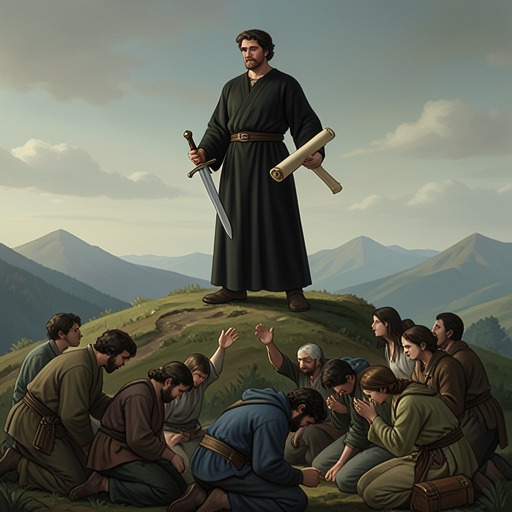
At the Judgment of the Wolf, Larys stood trial alongside Corlys Velaryon, both identified as central figures in the conspiracy. Corlys admitted his actions and defended them as necessary to end the crisis. Larys offered no comparable explanation. When asked to speak in his defense, he replied only that words would not move a wolf. Cregan Stark found both men guilty of murder, regicide, and high treason and condemned them to die.
Larys’s isolation at the trial reflected the way he had conducted himself throughout the conflict. He had changed sides as circumstances shifted, kept his own counsel, and rarely made his intentions legible. Corlys had supporters who petitioned for his life; no one spoke in Larys’s defense. He declined the option of taking the black and asked Cregan to remove his clubfoot after his death, describing it as a burden he had carried throughout life. Cregan granted the request. Larys died, and with him the last of the trueborn Strongs; his remains were entrusted to the silent sisters, while the foot was ordered buried separately. It later disappeared, though the story that it was stolen for sorcery is presented with skepticism.
The history makes Larys consequential without making him fully knowable. Its accounts connect him to the deaths of his father and brother, the political survival of Aegon II, the maneuvering around Corlys, and the poisoning that ended Aegon’s reign, but they do not settle every allegation or disclose a single, consistent motive. His silence functions both as a political technique and as a limit on what the narrative can establish. He survives the changing fortunes of the Dance by making himself useful to competing interests; when judgment finally catches up with him, the decisive record is not a confession but the testimony of others and the pattern of his concealed dealings.